
Zodiac Chart Calculator
A zodiac chart is more than a Sun sign. This calculator places the Sun, Moon and planets in the zodiac for your birth date, then summarises the chart the way astrologers often start a reading: the balance of elements and modalities, the rulers of your signs, and the current transits — where today’s planets fall against your birth planets — drawn together on one wheel.
- Free to use
- No sign-up
- Runs in your browser
Zodiac chart calculator
Zodiac Chart Pack
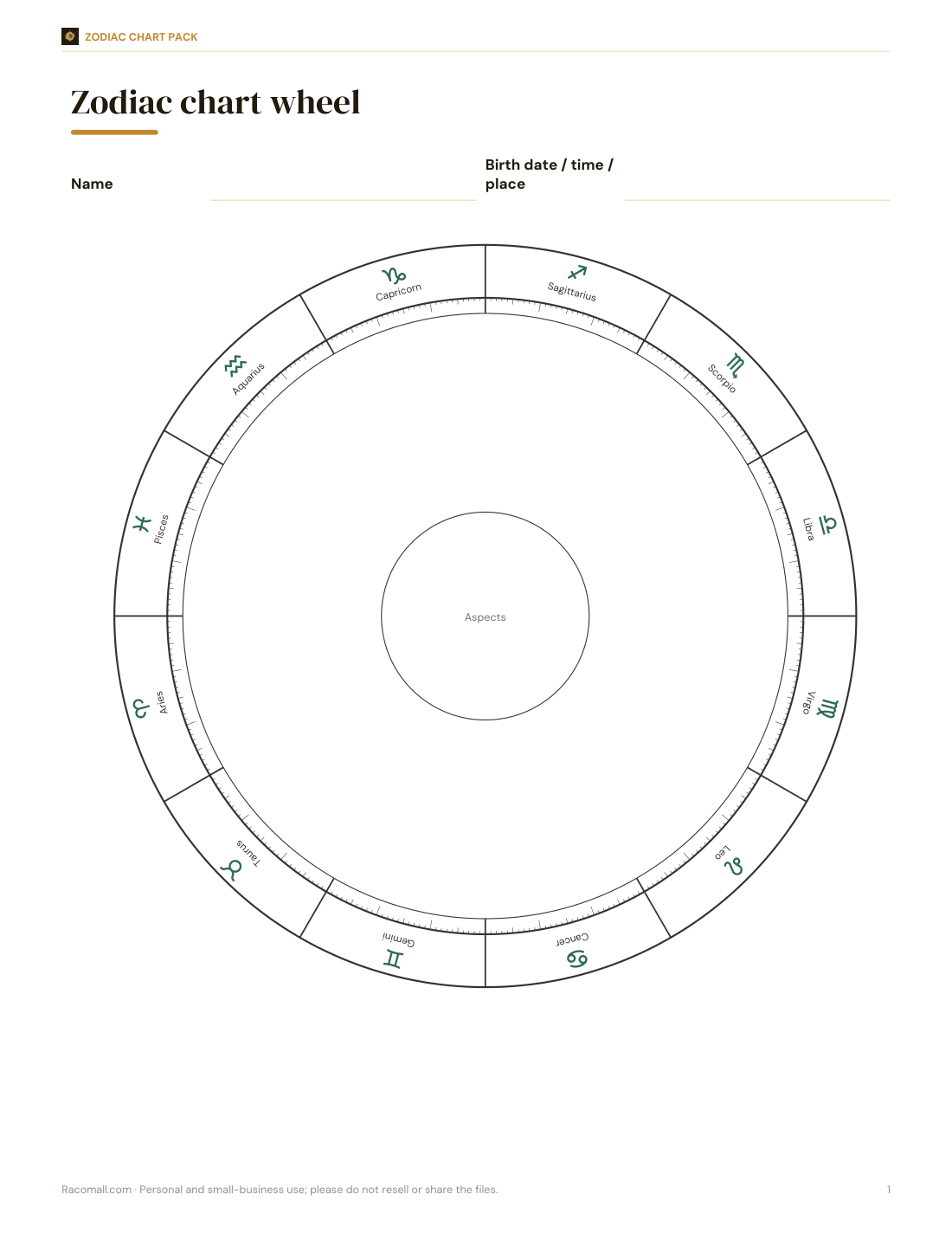
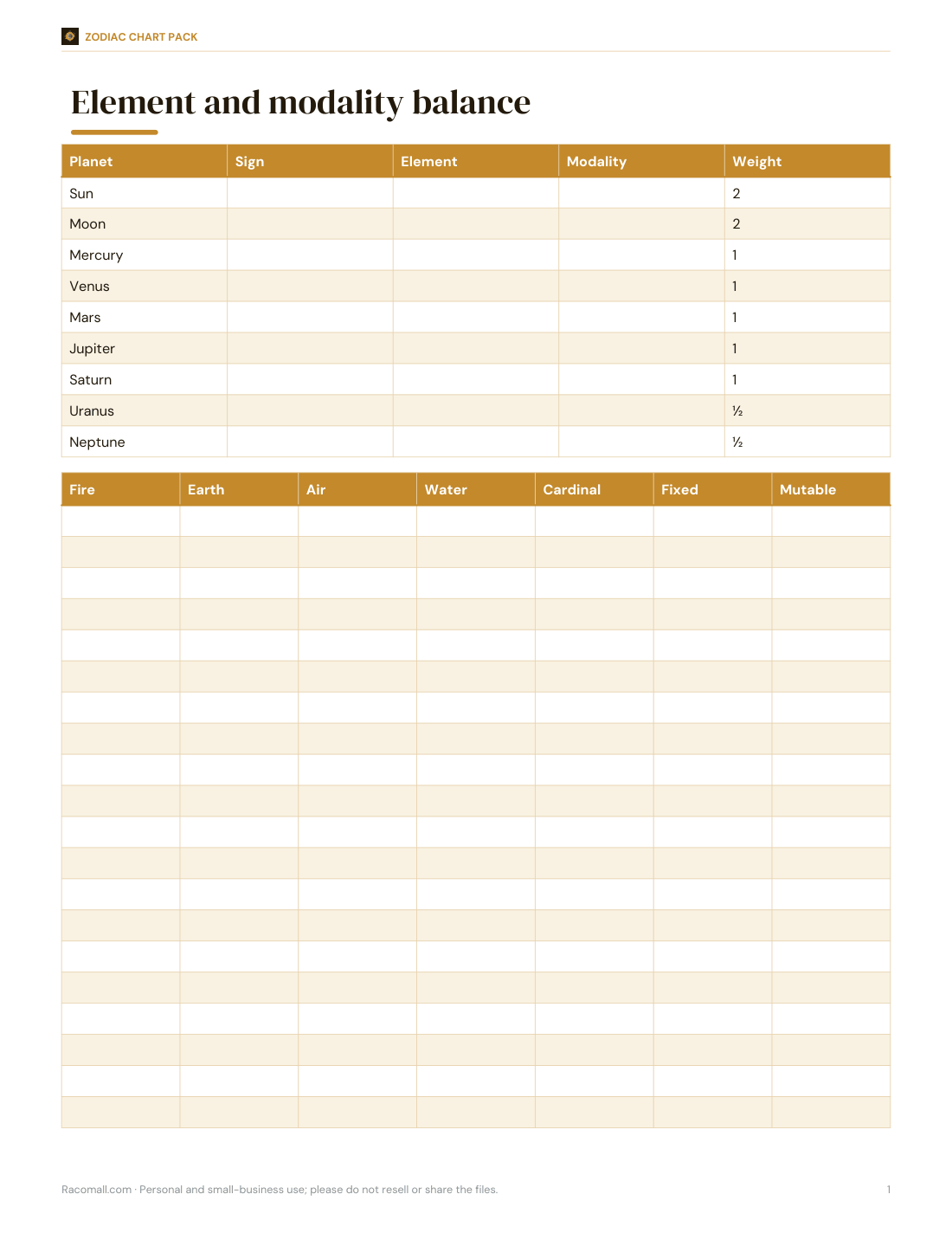
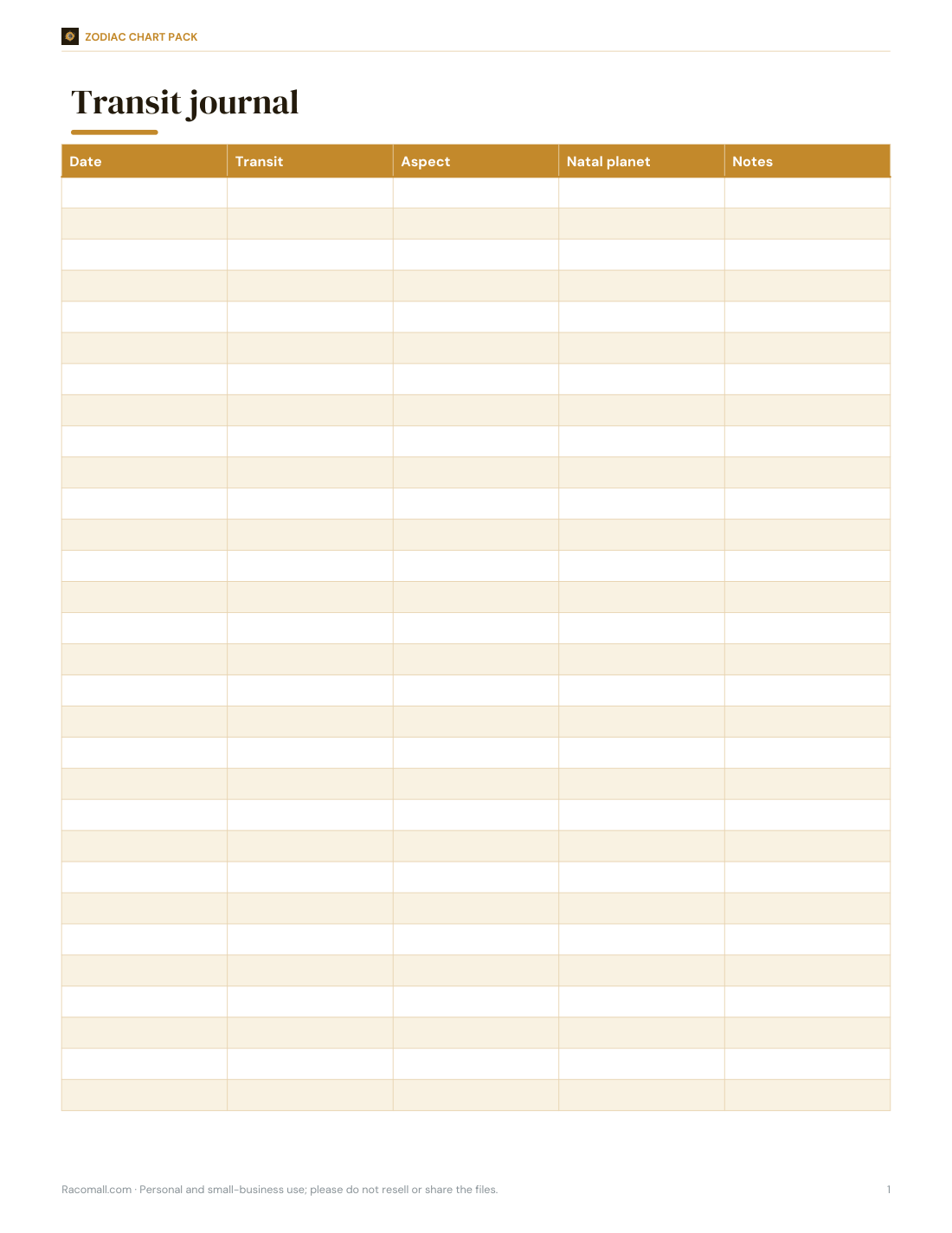
Printable zodiac chart set: blank chart wheel, element and modality worksheet, transit journal and sign, ruler and aspect reference cards.
- Blank chart wheel (PDF)
- Balance worksheet (PDF/DOCX)
- Transit journal (PDF/DOCX/XLSX)
- Reference cards (PDF/XLSX)
Formats: PDF, DOCX, XLSX. Instant download after payment (link valid 72 hours, up to 5 downloads). AI-assisted: the templates were drafted with AI help and reviewed and laid out before publishing.
$5.00 USD, one-time 4 files · about $1.25 each
- Instant download
- 7-day refund
- Secure checkout by Stripe
7-day money-back guarantee. Full refund within 7 days of purchase, even after you download.
Free sample: Blank Zodiac Wheel (PDF, 91 KB)
Full refund within 7 days — see the refund policy and license.
Free printables
Single sheets you can print right now, no sign-up. The full pack adds every sheet in one download plus the editable files.
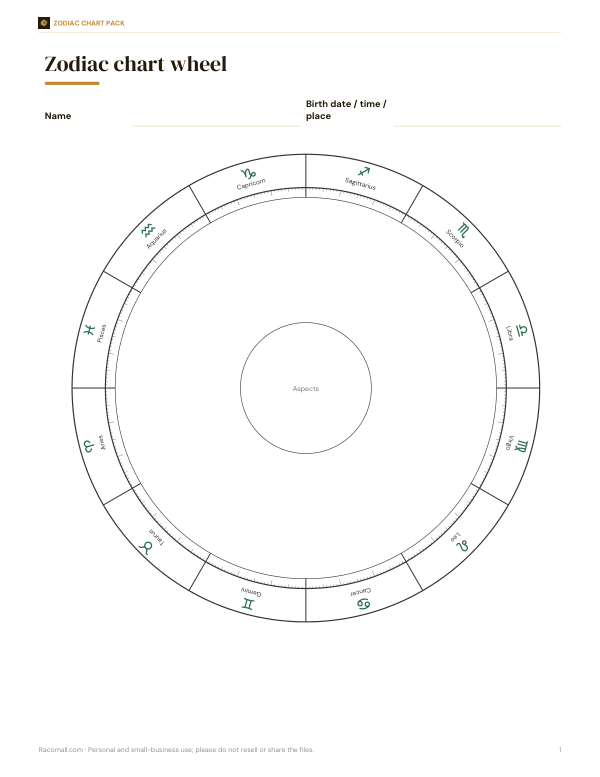 Printable Zodiac Chart Wheel
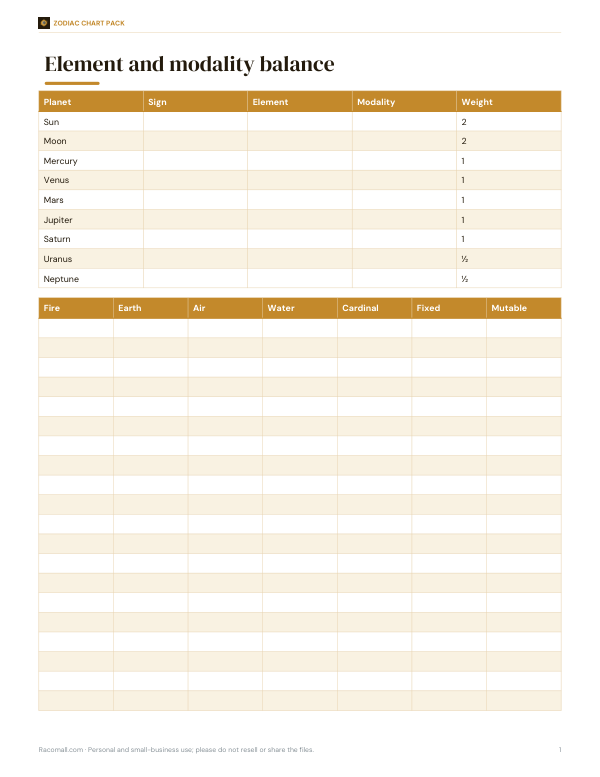 Printable Zodiac Balance Worksheet
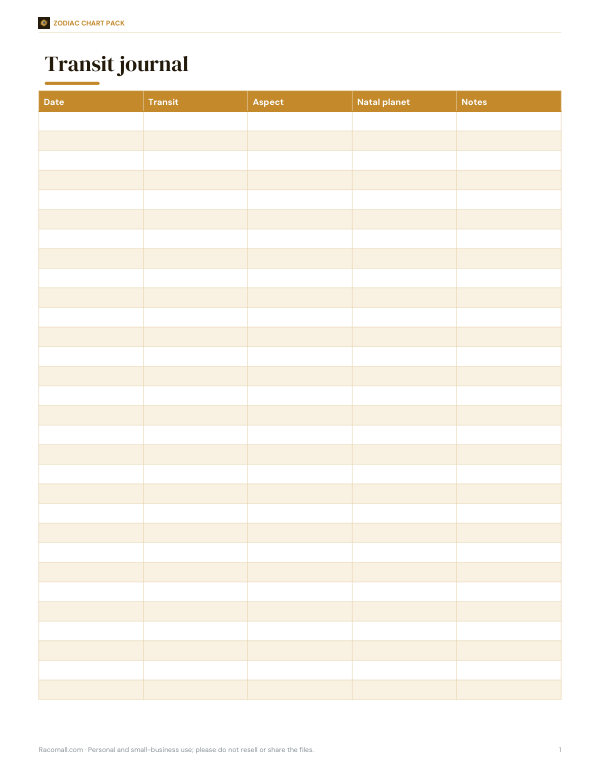 Printable Transit Journal
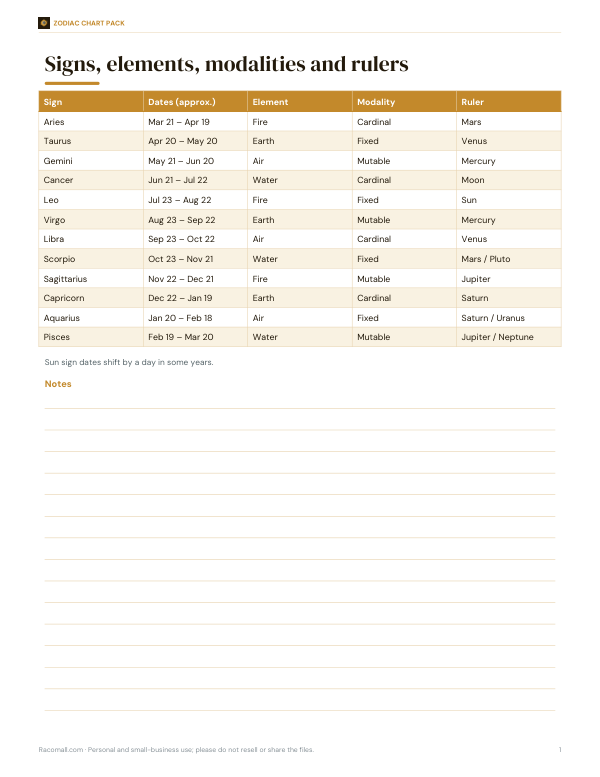 Printable Zodiac Chart Reference Cards
What the chart shows
Your birth chart places each planet at a point in the zodiac — the band of twelve 30° signs along the Sun’s yearly path. This calculator works out those positions astronomically for the moment you give (planets to within a fraction of a degree, which is plenty for sign placement) and then summarises them. The inner ring of the wheel is your birth chart; the outer ring shows where the planets are on the transit date.
Elements and modalities
| Element | Signs | Traditional keywords |
|---|---|---|
| Fire | Aries, Leo, Sagittarius | Energy, enthusiasm, initiative |
| Earth | Taurus, Virgo, Capricorn | Practicality, stability, the senses |
| Air | Gemini, Libra, Aquarius | Ideas, communication, connection |
| Water | Cancer, Scorpio, Pisces | Feeling, intuition, empathy |
| Modality | Signs | Traditional keywords |
|---|---|---|
| Cardinal | Aries, Cancer, Libra, Capricorn | Starting, initiating |
| Fixed | Taurus, Leo, Scorpio, Aquarius | Sustaining, persisting |
| Mutable | Gemini, Virgo, Sagittarius, Pisces | Adapting, changing |
Astrologers count how many planets fall in each group to describe a chart’s overall emphasis. There is no single standard method; this calculator counts the Sun and Moon twice, the personal and social planets once, and Uranus and Neptune — which stay in a sign for years and are shared by everyone born around the same time — as half.
Sign rulers
| Sign | Traditional ruler | Modern ruler |
|---|---|---|
| Aries | Mars | — |
| Taurus | Venus | — |
| Gemini | Mercury | — |
| Cancer | Moon | — |
| Leo | Sun | — |
| Virgo | Mercury | — |
| Libra | Venus | — |
| Scorpio | Mars | Pluto |
| Sagittarius | Jupiter | — |
| Capricorn | Saturn | — |
| Aquarius | Saturn | Uranus |
| Pisces | Jupiter | Neptune |
In traditional astrology each sign has a planetary ruler, and the sign and condition of that planet is read as colouring the sign. The calculator shows the ruler of your Sun sign and where that planet was at your birth — a starting point for following the chain of rulerships through a chart.
Transits
| Aspect | Angle | Orb used here |
|---|---|---|
| Conjunction | 0° | 3° |
| Sextile | 60° | 2° |
| Square | 90° | 3° |
| Trine | 120° | 3° |
| Opposition | 180° | 3° |
A transit is an aspect between a planet’s current position and a planet in your birth chart. Slow planets (Jupiter, Saturn, Uranus, Neptune) make transits lasting weeks or months, and astrologers give them the most weight; the Sun, Mercury, Venus and Mars pass quickly. Orbs — how close an aspect must be to count — vary between astrologers; tight orbs are used here so the list shows only exact-ish contacts.
Worked example
For a birth on 14 March 1992 at noon UTC, the Sun is at about 24° Pisces (a water, mutable sign ruled traditionally by Jupiter) and the Moon late in Cancer — close enough to Leo that the calculator warns the birth time matters. Venus is also in Pisces, Mars and Saturn are in Aquarius, Jupiter is in Virgo, and Uranus and Neptune are both in Capricorn, a combination shared by everyone born in the early 1990s. With the weighting used here, water scores 5 and fire only 1, and cardinal and mutable tie at 4. Jupiter, the traditional ruler of Pisces, sits in Virgo, the opposite sign. Changing the transit date to a birthday shows the Sun returning to its birth position — the “solar return”.
Birth time and time zone
Most planets barely move in a day, so a date alone is usually enough for their signs. The Moon moves about 13° a day and changes sign every two to three days, so the calculator warns you when the Moon changed sign within 12 hours of the time you entered. Enter your birth time in local clock time and the UTC offset in force then — for example −5 for US Eastern Standard Time, −4 for Eastern Daylight Time, +1 for Central European Time or +8 for China Standard Time.
Reading a balance
- A strong element is often described as a natural way of approaching life — fire through action, earth through practical results, air through ideas, water through feelings.
- A missing or weak element is sometimes read as something a person seeks out in others or develops over time.
- Modalities describe pace: cardinal signs start things, fixed signs keep them going, mutable signs adapt and finish.
- Planets in the same element tend to be in trine (120°), a flowing aspect; planets in the same modality but different elements tend to be in square or opposition.
What’s not included
- The rising sign (ascendant) and houses need an exact birth time and birthplace; use a full birth chart calculator for those.
- Pluto, the lunar nodes and asteroids are left out.
- Positions are tropical (the Western zodiac); sidereal (Vedic) positions are about 24° earlier.
- Astrology is a cultural and interpretive practice, not a science; this tool describes positions and traditional meanings, not predictions.
The chart pack
The optional pack includes a blank printable zodiac wheel for drawing charts by hand, an element and modality worksheet, a transit journal, and reference cards for signs, rulers and aspects. The calculator on this page is free.
AI-assisted content
This page was drafted with AI assistance and reviewed before publishing. Planet positions are computed with published approximate orbital elements.
Frequently asked questions
What is a zodiac chart?
A map of where the Sun, Moon and planets were in the zodiac signs at a given moment, usually your birth.
What are the four elements in astrology?
Fire, earth, air and water, each with three signs.
What is a transit?
An aspect between where a planet is now and where a planet was in your birth chart.
Do I need my birth time?
For the planets’ signs, usually not; for the Moon it can matter, and for rising sign and houses it is essential.
What is my chart ruler?
Strictly, the ruler of your rising sign; without a birth time, many people look at the ruler of their Sun sign instead.
Is this the Western or Vedic zodiac?
The Western (tropical) zodiac.